
A Guide to Temporary Storage for Moving House in Bangkok

MeSpace Self Storage Specialist Team
Categories : Blog
3 min read • Oct 12, 2026
Key Takeaways
- The three main options for storage for moving house are a self-storage unit, a portable container, or holding items with the moving company itself, each with different trade-offs on cost, access, and handling.
- Self-storage is usually the most affordable of the three, since you pay only for the sqm you use, on a month-to-month term, without delivery fees or bundled labor costs.
- A locker or XS unit from 0.6 sqm handles a few boxes and a mattress; a full studio or one-bedroom usually needs an M or L unit. Oversizing your unit costs more than sizing right the first time.
- MeSpace's flexible terms for temporary storage let you move up or down in unit size mid-lease without penalty, which matters when your move dates shift or your keep-pile shrinks.
- Our sister company JVK Movers, also under SCGJWD, handles the moving side if you want a single group to coordinate both the transport and the storage.
Table of Contents
- A Guide to Temporary Storage for Moving House in Bangkok
- Where movers typically store belongings between homes
- Common reasons movers need temporary storage
- Comparing costs: self storage, portable containers, and mover storage
- Small storage for moving house: sizing it right
- How MeSpace supports moving-house storage
- Take the stress out of your next move
- Frequently Asked Questions About Temporary Storage for Moving House
Moving day rarely lines up cleanly. Your old landlord wants the unit empty by the end of the month, but your new place isn't ready for another three weeks, and your furniture needs to go somewhere in between. A friend's spare room can only hold so much, and paying movers to hold everything in transit usually costs more than a short-term storage unit would.
The good news is that Bangkok has plenty of options for storage for moving house, and picking the right one is mostly about how long you'll need it and how often you'll want to get to your things. Below, we'll walk you through where movers typically park their belongings between homes, what a small unit actually costs, and how to size it so you're not paying for space you don't use.
Where movers typically store belongings between homes
There are three main routes people take for where to store belongings temporarily while moving house: a self-storage unit, a portable container that gets delivered and picked up, or holding items with the moving company itself as part of the moving service.
Each option has its perks.
- Self-storage: gives you access to your things whenever you need it, which matters if you plan to move belongings in stages or need to pull out a box before the new place is ready.
- Portable containers: these get delivered to you and picked up on a schedule, which is convenient but tied to the delivery windows.
- Mover-held storage: less handling on your end, but also less access to your things while they're in storage.
If you're using a full-service mover, ask whether they can handle both transport and storage. Our sister company JVK Movers, also under SCGJWD, works this way and coordinates with us at MeSpace directly when you need both.
Common reasons movers need temporary storage
Most people don't plan to need temporary storage for moving, but it often ends up being necessary. One common reason is due to the gap between move-out and move-in dates, especially when a new lease or purchase closes later than the old one ends.
Renovation is the second big reason. When furniture has to be out of the way before it can go back in, a storage unit gives contractors room to work without piling everything into another room of the house.
Downsizing is the third. When you're moving from a larger place to a smaller one, you often need somewhere to put the belongings you haven't decided about yet, such as an extra sofa, the second dining table, or boxes of things you aren't ready to sell or give away.
Comparing costs: self storage, portable containers, and mover storage
If you’re wondering what the most affordable storage option is for moving house, self-storage almost always wins on cost per month.
- Self storage: you pay for the exact sqm you use, on a month-to-month term. There's no delivery fee, no pickup fee, and the utilities are already handled by the facility. That's the leanest of the three options.
- Portable containers: these layer delivery and pickup fees on top of the monthly storage cost. If you only need storage for a week or two, the delivery fees can double what you'd pay for a self-storage unit of the same size.
- Mover-held storage: often the priciest option, since it's usually bundled into a full-service moving package. You're paying for the labor of moving your things twice (into storage, then out again), plus the storage fee itself. It's a good option if you want zero handling on your end, but a premium one.
Small storage for moving house: sizing it right
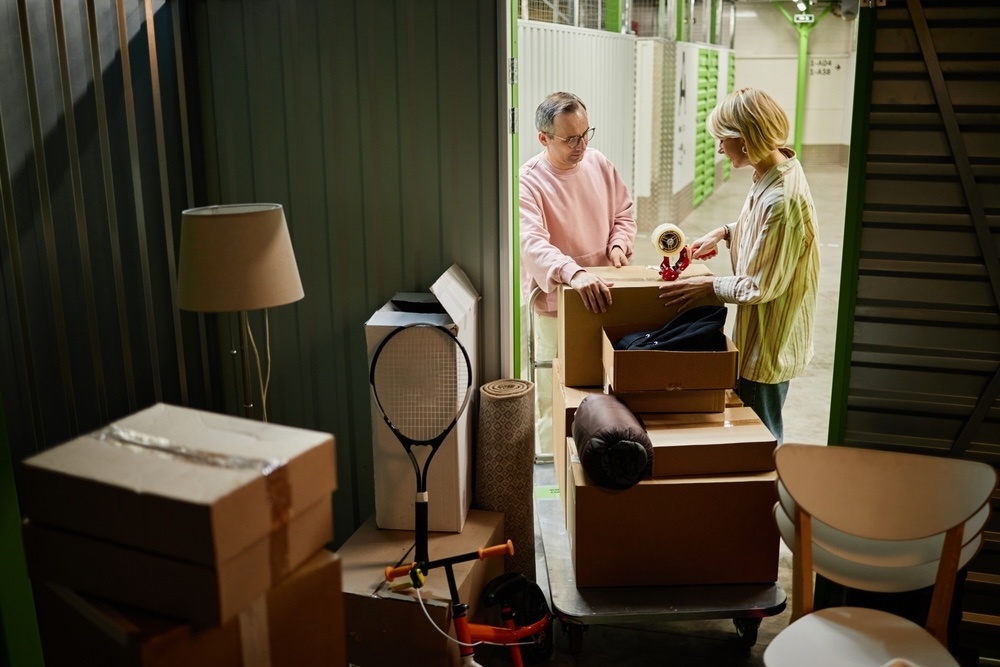
Sizing is where most movers overpay. At MeSpace, our smallest units start at 0.6 sqm, which is enough for a few boxes, a mattress, and a couple of chairs, which is often the full inventory for a condo move.
Here’s a rough sizing guide for getting the right amount of storage:
- A locker or XS unit for a handful of boxes
- An XS or S unit for a studio's essentials
- An M or L unit for a full studio or one-bedroom
- A larger L or above for a two-bedroom or a family move with furniture.
The cost difference between a right-sized unit and one size bigger adds up over a few months, so it's worth measuring your load with a size guide before you book.
If you’re seeing boxes blocking the walkway, needing to shift half your things to reach the one you actually want, or have a stack that's leaning in a way you don't trust, it's time to size up your storage.
How MeSpace supports moving-house storage
At MeSpace, we built our terms around moving needs. With us, you can rent from 1 month up to 12 months, and there's no penalty for changing unit size mid-lease if your storage pile grows or shrinks. Prepaying a longer term usually gets you a better effective monthly rate.
Our unit sizes run from 0.6 sqm lockers up to 50 sqm, covering everything from a few boxes to a full household. Branches sit across Bangkok, and Phuket, with several within easy reach of major moving routes for a same-day drop-off.
Every unit comes with 24-hour access and insurance coverage for furniture and electronics sitting in storage. Access is protected by personal PIN entry and 24-hour CCTV, so your things stay secure no matter the time you need for moving.
Take the stress out of your next move
When moving, the common choices for storing your belongings usually come down to a self-storage unit, a portable container, or mover-held storage based on how much access you need and how much handling you want to do yourself. Among the choices, self-storage tends to cost the least per month because sqm and term length can be matched exactly to what you're storing.
Here at MeSpace, we offer month-to-month self-storage from 0.6 sqm lockers up to 50 sqm units across Bangkok, Pattaya, and Phuket, with no penalty for upgrading or downgrading mid-lease. If you also need help with the moving side, our sister company JVK Movers can coordinate the transport as part of the same group.
Explore temporary storage options for self-storage in Bangkok with MeSpace today. We can help match a unit size to your move before your old lease runs out. Contact us and we'll help you work out what you need.
References:
JVK Movers | Full-Service Moving Company for Domestic and International Relocation. Retrieved February 12, 2026, from https://www.jvkmovers.com/en/
Frequently Asked Questions About Temporary Storage for Moving House
Q: How long can I rent temporary storage when moving house?
A: MeSpace terms run from 1 month up to 12 months, and you can extend beyond that if your move takes longer. Month-to-month flexibility is one of the reasons self storage suits moves that don't finish on schedule.
Q: Is short-term storage safe for furniture and electronics?
A: Yes, in a clean, dry, secure facility with insurance coverage. For electronics or wooden furniture, a temperature-controlled unit gives you better protection against Bangkok's heat and humidity than an ambient one.
Q: Can I access my things during temporary storage between moves?
A: With MeSpace, yes, 24/7. You get personal PIN access to your unit and can visit whenever you need to, whether that's to grab a box you forgot or drop off more items as the move continues.
Q: What size unit do I need for a one-bedroom move?
A: A one-bedroom move usually fits into an M or L unit, roughly 5 to 10 sqm depending on how much furniture you're keeping. If you're only storing the essentials while renovating, an XS or S unit may be enough.
Q: Can MeSpace also help with the moving itself?
A: Our sister company JVK Movers, also under SCGJWD, handles the moving side. If you need both transport and storage, we can coordinate the two together so you're dealing with one group instead of two.
Written by MeSpace Self Storage Specialist Team
The MeSpace specialist team consists of more than 20 team members across Storage Consultants, Senior Storage Consultants, and our Call Center, overseeing storage rental services across all 9 branches in Bangkok, Pattaya, and Phuket for 9 years, having served over 5,000 customers. The content in this section is drawn from the firsthand experience of our Storage Consultants, who speak with customers on the ground every day, covering everything from everyday household storage needs and cost-conscious SMEs to businesses with specialized storage requirements, such as products requiring FDA registration. Every recommendation from space-efficient packing methods and choosing the right unit size for your inventory to the security standards you should look for is reviewed by a Senior Storage Consultant before publication.
Relate Blog